Part One
This episode of Changing Times on the Acts Media Group network features hosts Mary Byrne and Lynn Morris celebrating America’s upcoming 250th birthday (the semiquincentennial). They are joined by Greene County Presiding Commissioner Bob Dixon and retired U.S. Army Reserves Major Susan Wilson to discuss the nation’s foundational principles, regional history, and the enduring meaning of freedom.
Key Points & Themes
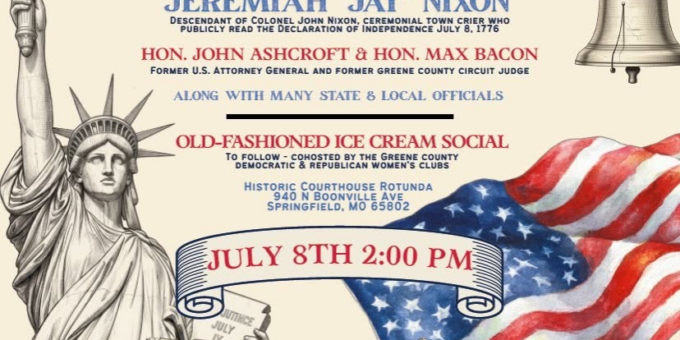
Greene County 250th Celebration: Presiding Commissioner Bob Dixon details a special, non-partisan public event scheduled for Wednesday, July 8th at 2:00 PM at the Historic Greene County Courthouse (940 Booneville). The ceremony features a live reading of the Declaration of Independence by former Missouri Governor Jay Nixon—a direct descendant of Colonel John Nixon, the merchant who first read the document publicly on July 8, 1776, in Philadelphia. Former U.S. Attorney General John Ashcroft and former Judge Max Bacon will lead the national anthem, followed by a collaborative community ice cream social.
A Symbolic Commitment to Liberty: Attendees at the Greene County event can receive custom parchment copies of the Declaration of Independence. The copies include a line for individuals to sign their names as a symbolic reaffirmation of their personal commitment to the principles of liberty and self-governance.
- Mayflower Heritage and the Motive of Faith: Major Susan Wilson shares her personal family lineage as a descendant of Mayflower passenger Edward Fuller. She highlights the heavy sacrifices made by the pilgrims, noting that half the settlers died during the brutal first winter but refused to return to England. The hosts contrast the Plymouth settlement with older, economically driven colonies like Jamestown, emphasizing that the Mayflower Compact served as a spiritual and structural precursor to the Declaration of Independence because it was rooted in the pursuit of religious freedom.
- Civics, Civility, and Natural Law: The broadcast addresses a modern decline in public etiquette and social media civility. The panel tracks the legal philosophy of the Declaration back to English jurist William Blackstone’s concept of “the laws of nature and nature’s God,” asserting that human rights are fundamentally derived from God rather than granted by government or monarchs.
- Education and the Biblical Roots of Governance: The discussion explores the historical connection between early American ideas of a republic and biblical texts like Exodus, which outline a system of selecting leaders from an educated citizenry. The hosts advocate for restoring thorough civic and historical education in public schools to equip future generations to actively preserve and defend the republic.
Part Two
- 250th Anniversary Reading: The hosts highlight the 250th anniversary of the first public reading of the Declaration of Independence. They mention a local celebratory event organized by Presiding Commissioner Bob Dixon at the old Greene County Courthouse in Springfield, Missouri, featuring a reading and hymns sung by former Governor John Ashcroft and Judge Max Bacon.
Educational Presentation: Thomas Jefferson’s Perspective
The episode features a dramatic presentation from the U.S. National Archives detailing Thomas Jefferson’s role in drafting the Declaration of Independence:
- Legacy Choices: Jefferson notes that he wished to be remembered only as the author of the Declaration, the author of the Virginia Statute for Religious Freedom, and the father of the University of Virginia—intentionally excluding the political offices he held.
- The Drafting Committee: He describes working alongside John Adams, Benjamin Franklin, Roger Sherman, and Robert R. Livingston. He explains that he was chosen to write the primary draft in part because he was from Virginia (which helped unite the southern colonies) and because his habitual silence during debates meant his pen would draw fewer political enemies.
- The Omitted Slavery Grievance: Jefferson recounts that his original draft contained a direct paragraph strongly condemning the British slave trade. This clause was entirely struck out by Congress to maintain consensus and secure the critical signatures of southern colonies like Georgia and South Carolina.
Panel Discussion: The Philosophical & Spiritual Roots of America
Following the presentation, Dr. Mary Byrne leads a discussion on the foundational ideology of early America:
- The Mayflower Compact: Dr. Byrne emphasizes that America’s true ideological and legal framework began with the Mayflower Compact in 1620, which she notes established a culture grounded in a biblical worldview.
- Historical Literature & Education: She references several academic books—such as The Hebrew Republic (Harvard University Press) and Reading the Bible with the Founding Fathers (Oxford University Press)—to argue that the early American mind was profoundly shaped by seminary-educated founders and Christian values.
- Critique of Modern Education: The hosts critique modern shifts in the public education system, arguing that a focus on “workforce development” has replaced the traditional goal of cultivating leaders well-versed in civics, original primary sources, and foundational history.
Episode Wrap-up & Previews
- Sponsor Acknowledgments: The hosts highlight long-time local partners, including Ozark Retirement Group and Springfield Nissan/Kia.
- Upcoming Content: They preview the next episode, which will cover Constitutional Amendment 4 in the upcoming Missouri election, as well as the 33rd annual Acts Festival (ActsFest).